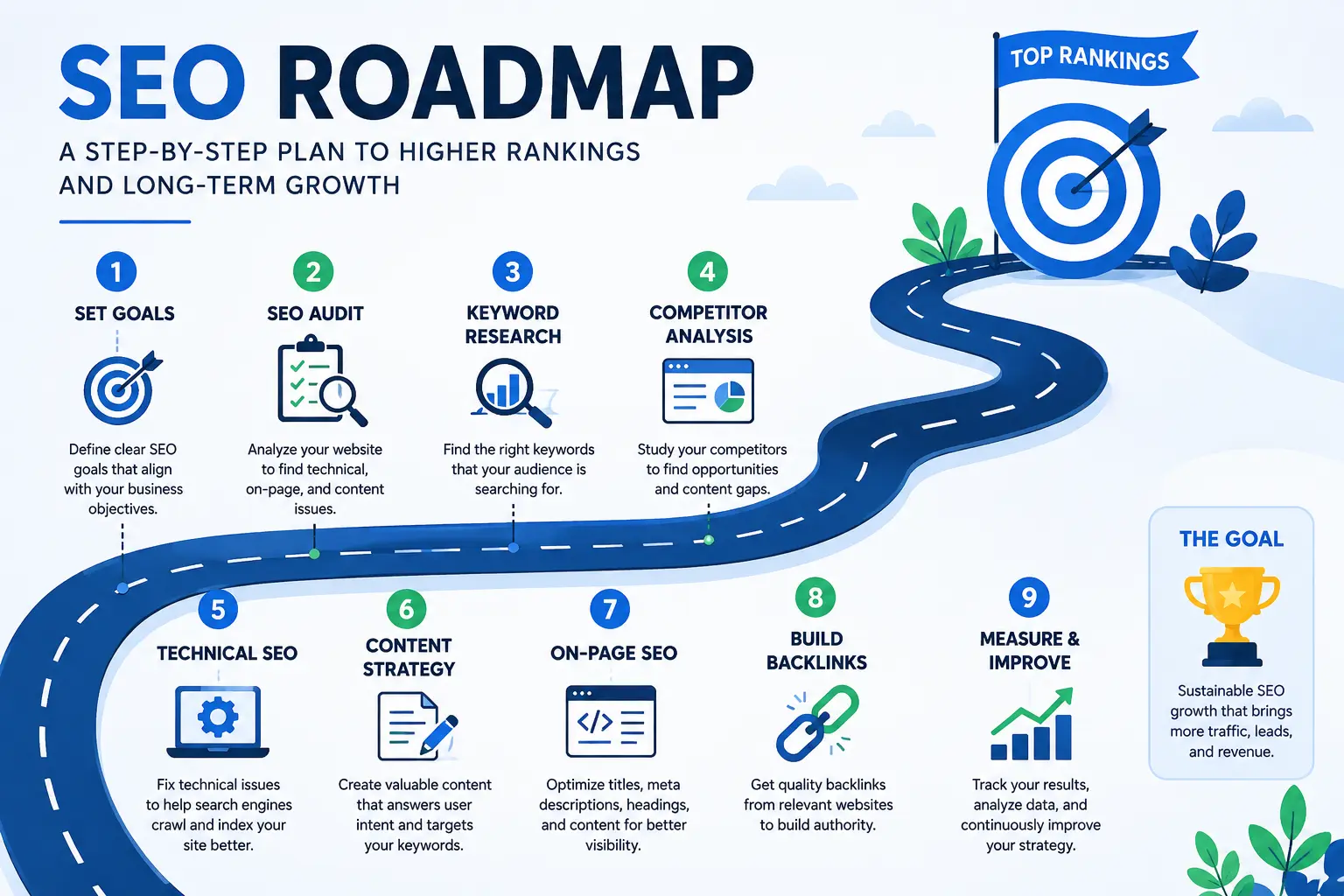
An SEO roadmap is a plan that turns “we should rank higher” into a list of tasks, owners, and dates. Without one, you’re just guessing and hoping Google notices. With one, you know exactly what to do this month, next month, and six months from now.
Business owners in Dubai ask us for this constantly. They’ve read ten blog posts about SEO and still don’t know where to start. This one’s different. We’re skipping the fluff and giving you steps you can use today, whether you run the SEO yourself or hire an agency to do it.
Table of Contents
- What Is an SEO Roadmap (And Why Most Fail)
- Step 1: Set Goals You Can Actually Measure
- Step 2: Audit Where You Stand Right Now
- Step 3: Research Keywords the Local Way
- Step 4: Fix Your On-Page and Local Foundations
- Step 5: Build Content That Builds Authority
- Step 6: Earn Links Without Wasting Months
- Step 7: Prioritize Like You Mean It
- Step 8: Set Milestones and Assign Owners
- Step 9: Track, Review, Repeat
- Sample 90-Day Roadmap
- How LRO Turns This Roadmap Into Results
- Conclusion
- FAQS
What Is an SEO Roadmap (And Why Most Fail)
Most roadmaps die in a Google Doc nobody opens again. They list forty tasks with no owner, no deadline, and no connection to revenue. Three months later, nothing’s changed, and nobody knows why.
A real one is different. It’s tied to business goals, not just rankings. It has dates. It has names next to tasks. And it gets revisited, not filed away. That’s the whole point of building a plan that survives contact with real work.
Step 1: Set Goals You Can Actually Measure
Don’t start with “improve SEO.” That’s not a goal, it’s a wish. Start with something like “grow organic leads by 25% in nine months.”
Once you’ve got that, pick two or three SEO KPIs to track. Organic traffic, keyword rankings, and conversion rate usually do the job. Pick numbers you can actually pull from a dashboard, not vague vibes about visibility.
And be honest about your budget and team size here. A one-person marketing team can’t execute the same plan as an in-house team of ten. Your goals should match your resources, not some case study you read online.
Step 2: Audit Where You Stand Right Now
You can’t build an SEO roadmap on guesses. Run a technical SEO audit first. Check site speed, broken links, duplicate pages, and whether Google can crawl everything properly.
Mobile matters more here than almost anywhere else. Most UAE users browse on their phones, so a clunky mobile site kills your rankings before you’ve even started. Test load times on a real phone, not just a desktop browser.
While you’re at it, pull your current numbers. Traffic, rankings, click-through rate. This becomes your baseline. Six months from now, you’ll compare against it to see if any of this actually worked.
Skip this step and your whole SEO roadmap gets built on shaky ground. Every later decision depends on knowing where you’re actually starting from.
Step 3: Research Keywords the Local Way
Generic keyword research misses half the opportunity if you’re targeting Dubai or the wider UAE. People search in English and Arabic, often for the same thing, so cover both where it makes sense.
Think in neighborhoods too. “Best dentist in Downtown Dubai” behaves very differently from “best dentist Dubai.” One’s specific, low competition, and closer to someone ready to book. Go after those first.
So don’t just chase the biggest search volume number you can find. A keyword with 300 searches a month that converts beats one with 5,000 searches and zero buying intent. Every time.
This is local SEO in its simplest form: matching what people search with the exact place they’re searching from.
Step 4: Fix Your On-Page and Local Foundations
On-page SEO is unglamorous, but it works. Title tags, headers, meta descriptions, and internal links get these right on every important page before you do anything fancier.
Claim and fill out your Google Business Profile. Add your real address, hours, photos, and services. Keep your name, address, and phone number identical everywhere online. Inconsistent details confuse Google and cost you local rankings.
Schema markup deserves a mention here too. It helps Google and AI tools understand exactly what your page is about. Skip it, and you’re leaving visibility on the table, especially now that AI Overviews pull from structured data first.
Step 5: Build Content That Builds Authority
Random blog posts scattered across random topics don’t build authority. Clusters do. Pick one pillar topic your business genuinely knows, then write supporting pieces that link back to it.
Your content strategy should center on one pillar per business area, not ten random ideas thrown at a wall.
Say you run a property firm. Your pillar might be “Buying Property in Dubai.” Supporting pages could cover mortgage rates, visa requirements, and neighborhood guides. Each piece works alone but strengthens the whole cluster.
Back up your claims with real sources. Link to government sites or recognized local bodies when relevant. It builds trust with readers and with Google, and that’s not something you can fake convincingly.
Step 6: Earn Links Without Wasting Months
Link building still moves rankings, whatever anyone tells you. But chasing hundreds of low-quality mentions wastes time and can actually hurt you.
Focus on a handful of relevant, respected sites instead. A mention on a solid local business directory or industry publication beats fifty spammy ones combined. Quality wins here, not volume.
Local citations matter specifically in the UAE, too. Get listed accurately on recognized regional directories. It’s slow, unglamorous work, but it compounds and strengthens your SEO roadmap over time in ways paid ads never quite replicate.
Step 7: Prioritize Like You Mean It
You’ve now got a giant list of tasks. Good. Now you need to cut it down because you can’t do everything at once, and trying will burn your team out fast.
Use a simple matrix: plot each task by impact versus effort. High-impact, low-effort tasks go first — these are your quick wins. High-impact, high-effort tasks get planned properly. Everything else waits or gets dropped.
Be ruthless about the “low-impact, high effort” tasks specifically. These eat time and deliver nothing. Cut them from your SEO roadmap before they cut into your months.
Step 8: Set Milestones and Assign Owners
A plan without owners is just a wish list. Every task needs a name attached, even if that name is you. Vague ownership means nothing gets done by anyone.
Set checkpoints too. Maybe your first milestone is finishing the technical fixes by the end of month one. Next might be publishing ten pieces of content by month three. These checkpoints keep momentum visible.
Build this into a 90-day plan if you want something manageable. Trying to map a full year in granular detail usually backfires. Review and extend it once you’ve hit your first checkpoints.
Step 9: Track, Review, Repeat
SEO [Search Engine Optimization] isn’t something you finish. It’s something you keep adjusting based on what’s actually happening, not what you assumed would happen.
Check your numbers monthly at a minimum. Did rankings move? Did traffic grow? And did any of it turn into actual leads or sales? If something’s flat, figure out why before adding more tasks on top.
Your SEO roadmap should evolve every quarter. What worked in month one might need tweaking by month six. Treat it like a living plan, not a document you write once and forget.
Sample 90-Day Roadmap
- Month 1: Technical fixes, mobile optimization, Google Business Profile setup
- Month 2: Neighborhood targeting, on-page fixes, localized content
- Month 3: Content clusters, early outreach, first KPI review
This isn’t a rigid formula. It’s a starting shape for your own SEO action plan, based on what actually needs fixing first for most businesses.
How LRO Turns This Roadmap Into Results
Reading a plan and executing one are two very different things. That’s where most businesses stall out, not in the planning stage.
At Lets rank online, an SEO agency in Dubai, we handle every piece of this for Dubai and Riyadh businesses. Our SEO team runs the audits and fixes the technical stuff. Our neighborhood-level team handles Google Business Profile, citations, and geographic targeting. Technical SEO covers site speed and crawlability. And our social media marketing keeps your brand visible while the organic side builds momentum.
We also stick to white hat SEO only. No shortcuts, no risky tactics that tank your rankings six months later. Just steady, compounding work that holds up over time.
Conclusion
An SEO roadmap only works if someone actually follows it. Pick your goals, audit honestly, prioritize hard, and revisit the plan every few months. That’s really the whole game.
Some businesses build this in-house, and that’s fine if you’ve got the time and the team. Others hand it to an SEO agency in Dubai, so it actually gets done instead of sitting in a folder somewhere, half-finished.
Want help building one specific to your business? Our team at Lets Rank Online builds custom SEO roadmaps for companies across Dubai and Riyadh. Reach out, and we’ll map yours out together.
FAQS
- How long does it take to see SEO results?
Usually three to six months for early movement, and six to twelve for solid, steady gains. Anyone promising overnight rankings is selling you something.
- What’s the difference between an SEO strategy and a roadmap?
That’s the thinking behind your approach. The roadmap turns that thinking into dated, assigned, trackable tasks.
- Do I need a technical audit before anything else?
Pretty much, yes. Content and links won’t help if Google can’t crawl or load your site properly in the first place.
- Can a small business handle this without an agency?
Some of it, sure. But a full SEO checklist covering technical, content, and links takes real time; most small teams don’t have spare time.
- How often should I update my roadmap?
Review it monthly, and do a bigger revision every quarter. Markets shift, competitors move, and your plan should move with them.
Recent Comments